Blog · · voca9 Team
Work Routine Guide: Examples, Templates & Daily Schedules
Note on verification: I can’t run the search or URL-check tools in this response, so I haven’t verified live statistics or URLs. I’ve avoided unsourced numbers, kept research claims general and attributed, and marked the image URLs as placeholders to replace before publishing. Please confirm the external link and the images before going live.
A work routine is a repeatable daily structure that sets when you plan, focus, collaborate, take breaks, and stop. A good routine removes daily decisions about what to do next, so more of your energy goes to the work itself. This guide covers a daily work routine, a morning work routine, examples for different schedules, and a free template you can adapt.
What Is a Work Routine and Why It Matters
A work routine is the pattern of your workday: when you start, how you sequence tasks, when you take breaks, and how you end. It’s different from a one-off plan because it repeats. Over time, the repetition becomes a cue that helps you shift into focus.
A consistent routine supports three things. It improves focus because you protect time for demanding work. It creates predictability for you and for colleagues. And it supports work-life balance because it sets a clear end point. This guide covers both your daily structure and the longer-term habits that keep it working.
Core Elements of an Effective Work Routine
Most effective routines include five building blocks:
– Start-of-day planning: a short review of priorities before email or messages.
– Deep work blocks: uninterrupted time for your most demanding tasks.
– Meetings: grouped where possible so they don’t fragment focus time.
– Breaks: short pauses, movement, and a real lunch.
– Shutdown: a closing ritual that wraps up loose ends.
Find your peak energy hours. Notice when you concentrate best over a week or two. Many people think most clearly in the morning, while others peak in the afternoon. Schedule complex work in your peak window and routine tasks, such as expense reports or inbox triage, in the low-energy hours.
Quick routine audit. Answer yes or no:
1. Do I know my top three tasks before I open email?
2. Is at least one block of 60 minutes or more protected each day?
3. Do I take breaks that are not spent on my phone?
4. Do I have a clear point where the workday ends?
5. Do meetings sit in set blocks rather than scattered across the day?
Three or more “no” answers suggest your routine needs work.
Work Routine Examples for Common Schedules
A standard 9-to-5 office routine might look like this:
| Time | Block | Purpose |
|---|---|---|
| 9:00–9:20 | Planning | Review calendar, pick top three tasks |
| 9:20–11:00 | Deep work | Highest-priority project |
| 11:00–11:15 | Break | Water, walk, stretch |
| 11:15–12:00 | Messages | Email, chat, replies |
| 12:00–1:00 | Lunch | Away from the desk |
| 1:00–2:30 | Meetings | Grouped collaboration |
| 2:30–3:30 | Focused task | Second priority |
| 3:30–3:45 | Break | Short reset |
| 3:45–4:30 | Admin | Expenses, filing, updates |
| 4:30–5:00 | Shutdown | Review and plan tomorrow |
The structure changes with the working pattern. Remote workers need stronger boundaries, shift workers need sleep-protective timing, and hybrid workers need days grouped by purpose. The sections below cover each.
Morning Work Routine: Starting the Day with Focus
A strong morning sequence is simple: wake at a consistent time, review your plan, set priorities, and start the first focused task.
1. Wake and move: a steady wake time and a few minutes of light movement.
2. Review the plan: look at your calendar and task list, not your inbox.
3. Set three priorities: pick the outcomes that would make the day a success.
4. Start the first focused task before you check messages.
Where possible, avoid email for the first 30 to 60 minutes. Reactive work tends to set your agenda for the day if you let it. On busy mornings, shorten the routine rather than dropping it. Two minutes of priority setting is still better than none.
Healthy Work Routine: Building Breaks, Movement, and Nutrition into Your Day
A healthy work routine is a practical part of productivity, not a separate wellness project. Schedule breaks just as you would a meeting. Short movement breaks, glasses of water kept at your desk, and a lunch taken away from your workspace all help you return to tasks with clearer attention.
Research on breaks suggests that brief, well-timed pauses can help sustain attention during long tasks. A widely cited study by Ariga and Lleras (2011) found that brief, occasional breaks supported sustained performance on a vigilance task. The findings apply most directly to lab tasks, so treat them as supporting evidence for scheduled breaks rather than a guarantee.
If you experience persistent fatigue, unexplained changes in sleep or appetite, or ongoing difficulty concentrating, talk with a doctor. A routine can support your health, but it doesn’t replace medical care.
Time-Blocking Your Workday
Time blocking assigns each task a specific slot on your calendar. For a full walkthrough, see our time blocking guide. The basic steps are:
1. List tasks for the day or week.
2. Estimate durations for each, adding 20 to 30 percent for uncertainty.
3. Assign calendar blocks, starting with the most important work in your peak hours.
Here is a sample time-blocked day with buffers:
– 8:45–9:00: Planning
– 9:00–10:30: Project deep work
– 10:30–10:45: Buffer and break
– 10:45–11:30: Client follow-ups
– 11:30–12:00: Overflow buffer for unplanned work
– 1:00–2:00: Meetings
– 2:00–3:30: Second deep work block
– 3:30–4:00: Admin and messages
– 4:00–4:30: Shutdown
Buffers matter. Unplanned work will arrive, and a buffer lets you absorb it without rebuilding the whole day.
To protect blocks from meeting creep, mark focus time as busy on your calendar, decline meetings that lack an agenda, and ask recurring meetings to shorten to 25 or 50 minutes. If you use tasks and reminders, our effective to-dos guide and mastering reminders guide explain how to keep them connected to your calendar.
Remote Work Routine vs. Hybrid and Office Routines
Each setting changes the routine in different ways:
– Office: commuting creates natural transitions, and collaboration is easier but interruptions are more frequent.
– Remote: you save commuting time but lose the built-in boundary between work and home.
– Hybrid: you need consistent routines across two environments, so the schedule must travel with you.
To separate work from home life in a remote setup, try these tactics:
– Start ritual: make a coffee, review your plan, and open your work tools in the same order each day.
– Dedicated workspace: if possible, work from a defined area and leave it at shutdown.
– Commute substitute: take a 10-minute walk before and after work to mark the transition.
Sample remote day: 8:30 planning; 8:45–10:30 deep work; 10:30 break; 10:45–12:00 meetings and messages; 12:00–1:00 lunch away from the desk; 1:00–3:00 focused task; 3:00–3:15 break; 3:15–4:30 admin; 4:30 shutdown walk.
Sample hybrid week: Monday and Wednesday in the office for collaboration and meetings; Tuesday and Thursday at home for deep work; Friday for planning, reviews, and admin. Keep the start and end rituals the same on every day, regardless of location.
Shift Work Routine: Structuring Split Shifts, Rotating Rosters, and On-Call Work
Shift work makes it harder to keep a consistent routine, so the goal shifts from matching the clock to protecting sleep, meals, and recovery. The CDC’s sleep resources are a useful starting point for understanding sleep needs.
Plan around your sleep window first. Block out a consistent sleep period, then schedule meals and activities around it. Avoid large meals and bright screens just before sleep, and use blackout curtains or a sleep mask if you sleep during the day.
For rotating rosters, create a pre-shift ritual (a light meal, a short walk, reviewing handover notes) and a post-shift ritual (a wind-down routine, a snack, a dark room). Doing the same steps each time signals your body what comes next.
For on-call work, keep a charged phone, a clear list of escalation contacts, and a go-bag of essentials. Between call-outs, protect recovery time. After an unpredictable shift, decompress with a short walk, a quiet activity, or a few minutes of stretching before sleep.
Typical Work Routine by Job Type
Routines vary by role. Here are brief variations, each with one key adjustment:
– Healthcare staff: Structure handovers at the start and end of each shift, with a short break scheduled mid-shift. Adjustment: build recovery time after night shifts.
– Teachers: Use the early morning for lesson prep before students arrive, and block planning or grading after school. Adjustment: set a hard stop to prevent work spilling into evenings.
– Creatives: Reserve the first two hours for uninterrupted making, and group feedback and admin later. Adjustment: schedule breaks away from the screen to rest your eyes and body.
– Sales professionals: Start with a pipeline review, then cluster calls in the most responsive windows. Adjustment: end each day with CRM updates to avoid a backlog.
Routine Strategies for Neurodivergent Workers
Routines work best when they fit how you think. For people with ADHD, shorter time blocks (25 to 45 minutes) can feel more achievable than long stretches. Our Pomodoro timer guide explains one popular approach. Visual timers and external reminders can also help you notice time passing and transition between tasks.
Reduce friction by setting defaults. Decide in advance what your first task is, where your materials are, and what the next block will be. Build flexible transitions so that a delayed task doesn’t derail the whole afternoon.
Every routine should be adapted to individual needs. Test a structure, keep what helps, and drop what doesn’t.
Preventing Burnout with Scheduled Breaks, Shutdown Rituals, and Boundaries
A shutdown ritual signals the end of the workday. A simple version takes about 10 minutes:
1. Review what you completed today.
2. Write down the top three tasks for tomorrow.
3. Close open loops by noting unfinished items and any waiting responses.
4. Close apps and state clearly, “Work is done.”
Set working-hours boundaries by stating your hours to your team and turning off notifications after shutdown. Explain the reason in practical terms: you protect focus time and return with better output. If urgent requests come in after hours, agree on a clear channel for emergencies.
Schedule recovery breaks during the day and step away from work at lunch. Add a weekly review on Friday or Monday to check what worked, what drained you, and what to change. Our task management guide covers tools that make this review easier.
Adjusting Your Work Routine for Life Changes
New parents and caregivers often need flexible blocks. Identify one or two protected focus windows, such as during a partner’s shift or while a family member is asleep, and build the rest of the day around short, adaptable tasks.
For returners to work, ease in gradually. In the first week, work four hours a day focused on the highest-priority tasks. Add 30 to 60 minutes each week until you reach your full schedule. This prevents the overload that often causes early burnout.
Reassess your routine when circumstances change, such as a new role, a new commute, or a new family situation. Run the audit from earlier in this guide, identify what’s no longer working, and adjust one element at a time so you can see what helps.
Aligning Your Work Routine with Your Manager and Team
Start the conversation with a specific request. For example: “I’d like to protect two 90-minute focus blocks on Tuesday and Thursday mornings. Could we keep meetings out of those times?” Explain the benefit to the team, such as fewer interruptions and faster delivery on shared goals.
Coordinate across the team by agreeing on meeting-free periods, response expectations (for example, a same-day reply for chat and a 24-hour reply for email), and how urgent issues should be flagged. Write these norms down in a shared document so they’re easy to find and update.
What Research Says About Routines and Productivity
Research supports several parts of a routine, though the evidence has limits. Studies on brief breaks, such as the Ariga and Lleras (2011) work cited above, suggest that short pauses can help sustain attention on demanding tasks. Research on recovery from work, including studies by Sonnentag and colleagues, links psychological detachment from work during off-hours with better well-being.
Be cautious about overstating these findings. Many studies are small, use specific tasks, or rely on self-reported data. Routines that work for one person may not work for another, and few studies directly test the complete routines described in this guide. Treat the evidence as a reason to experiment, not a guarantee of results.
Work Routine Template and Planner (Free Download)
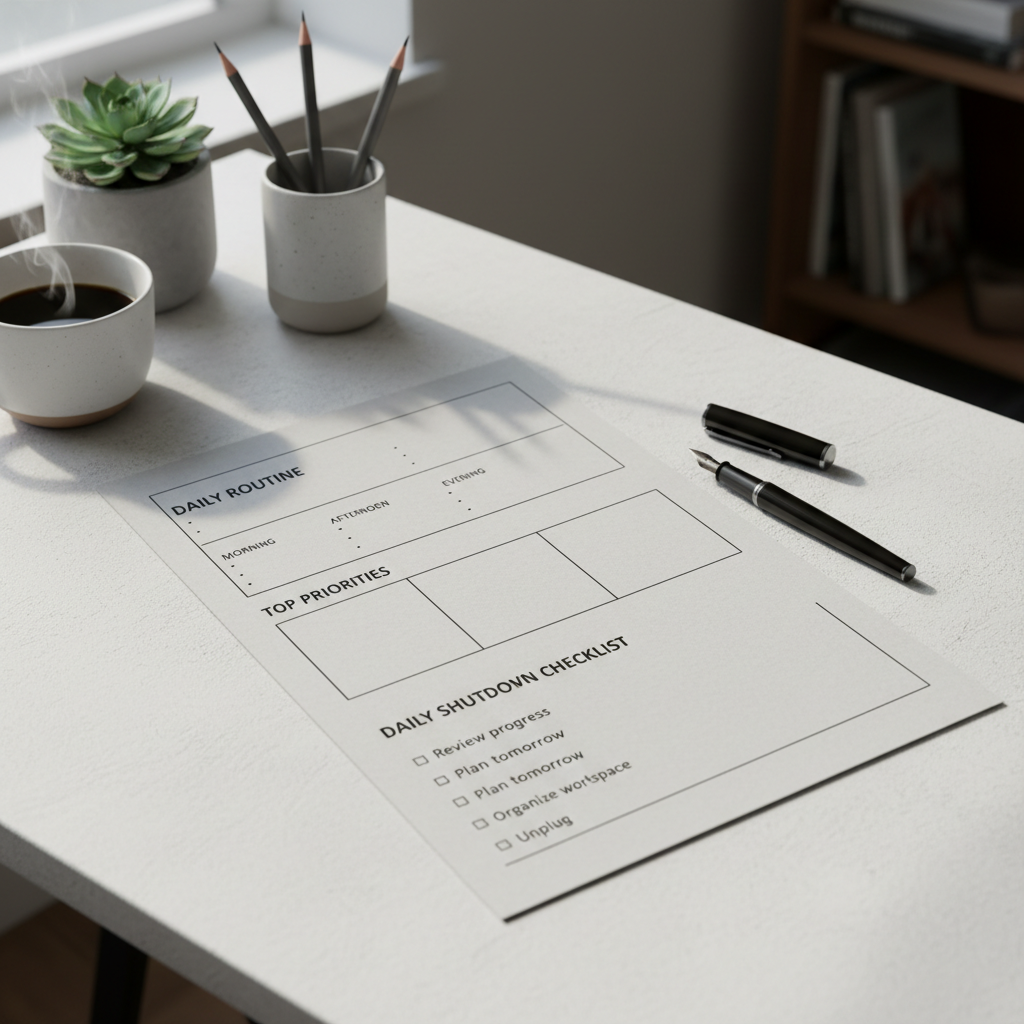
Use a printable daily planner to put this guide into practice. The template includes:
– Time blocks from start to finish of the day
– A top-three priorities section
– A buffer line for unplanned work
– A shutdown checklist
To customize it, adjust the time blocks for your schedule. Shift workers can shift the blocks to match their sleep window. Remote workers can add a start ritual and a walk marker. Hybrid workers can add a location line to each day.
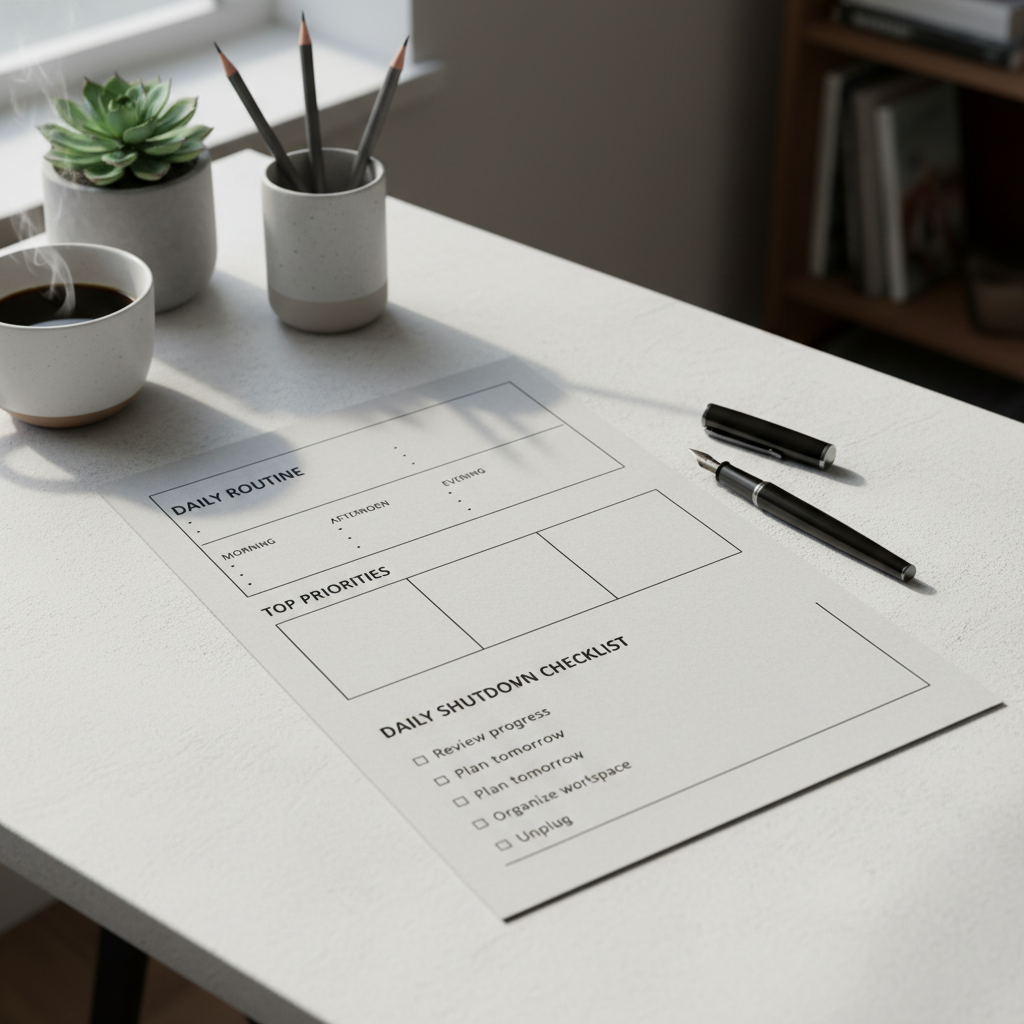
Download the free work routine planner (replace this link with the hosted file URL before publishing)
For digital options, see our best planner apps guide.
Build Your Work Routine in 5 Steps

1. Assess your current day (30 minutes). Track how you spend your time for three typical days. Note where energy and focus rise and fall.
2. Define your priorities (15 minutes). Choose the three to five outcomes that matter most each week. Our goals vs. objectives guide can help you distinguish the two.
3. Block your time (30 minutes). Place priority work in your peak hours, add meetings and breaks, and include buffers.
4. Test for one week. Follow the schedule as closely as you can and note what breaks down.
5. Adjust (20 minutes). Change one element at a time based on what you observed, then repeat the test.
Draft your routine: Fill in the blanks below.
– My peak focus hours are: ______
– My three priorities for this week are: ______, ______, ______
– My first focused task each morning will be: ______
– My shutdown time is: ______
– One change I’ll test this week is: ______
Frequently Asked Questions About Work Routines
How long should it take to build a new work routine?Most people need two to four weeks of consistent practice before a routine feels automatic. Expect some adjustment during that time.
What is a typical work routine for an office employee?A common pattern includes morning planning, a block of deep work, a midday break, grouped meetings, an afternoon focus period, and a short shutdown review. The sample schedule in the examples section shows one version.
How do I create a shift work routine that supports sleep?Set a consistent sleep window first, then schedule meals and activities around it. Keep your sleep environment dark and quiet, and use a pre-shift and post-shift ritual to signal transitions.
What is the best morning work routine for productivity?The best routine is the one you can repeat. A reliable pattern includes a short planning review, three priorities, and starting your first focused task before checking email.
How do I maintain a remote work routine without burning out?Use a start ritual, a dedicated workspace if possible, scheduled breaks, and a firm shutdown time. A weekly review helps you catch drift before it becomes exhaustion.
Key Takeaways
An effective work routine protects your focus, sets clear transitions, and includes breaks and a shutdown ritual. Adapt it to your schedule, whether you work in an office, remotely, on shifts, or with neurodivergent needs. Your next step: download the planner, complete the five-step draft, and test it for one week.
Updated